I remember sitting in my cramped apartment parking lot three years ago, staring at my brand-new Tesla’s battery sitting at a pathetic 4%. I had spent the previous week trying to sneak a charge from a dusty outlet in the shared laundry room, only to have my property manager threaten me with a lease violation notice the very next morning. It was a visceral, embarrassing moment of realization: I loved my car, but I was technically an ‘electric squatter.’ If you have ever felt that pit in your stomach while dragging a heavy-duty extension cord across a sidewalk, you know exactly what I am talking about. Today, I am going to show you how to stop hiding and start the process of getting a legitimate, permanent charging solution installed at your rental property. We are going to tackle the paperwork, the ‘Right to Charge’ laws, and how to handle the technical hurdles that usually make landlords run for the hills.
Your Landlord Cannot Just Say No Forever
Most renters assume they are at the total mercy of a grumpy property owner, but the legal landscape is shifting fast. In states like California, Colorado, and Florida, ‘Right to Charge’ laws have actually made it illegal for landlords to unreasonably deny a tenant’s request to install a charging station, provided the tenant pays for it. Early in my journey, I made the massive mistake of assuming my landlord would just be ‘cool’ with it if I offered to pay for the electricity. I didn’t realize that without a formal agreement and the specific permits required for multi-unit dwelling chargers, I was putting his insurance policy at risk. According to the Alternative Fuels Data Center, these local mandates are designed to protect you, but they require you to follow a very specific set of rules to stay protected. Before you even send that first email, you need to understand how to get your landlord to approve a level 2 installation by presenting a professional plan rather than a messy DIY project.
Is this legal headache actually worth the effort?
I get it—you’re wondering if you should just keep visiting the local Supercharger and scrolling through your phone for 40 minutes. But think about the convenience of waking up to a full ‘tank’ every single morning. The key is proving to your landlord that the install won’t blow up their electrical system. You need to help them see that you have done the math on how to calculate if your 100 amp service can handle a daily commute without tripping the main breaker for the whole building. Have you ever tried to pitch an upgrade to your landlord only to be shut down immediately? I want to hear about those roadblocks so we can break them down. If you’re feeling stuck, you can always reach out for a professional consultation to get a quote that will actually look credible on your landlord’s desk. Once you have the right data, the conversation shifts from ‘please let me do this’ to ‘here is the legal and safe way we are going to do this.’
Prove Your Building Won’t Go Dark
The biggest hurdle isn’t the physical charger; it’s the math. Your landlord’s main fear is that your car will suck so much juice that the rest of the building loses power during Monday Night Football. To kill this fear, you need a load calculation. Adding an EV charger to an old electrical panel is like trying to plug a high-end gaming PC into a daisy-chained power strip from the 90s; eventually, something is going to melt if you don’t check the capacity first. I remember my first attempt at this. I handed my landlord a printout from a random forum, and he looked at me like I was speaking Martian. It wasn’t until I showed him how to calculate if your 100 amp service can handle a daily commute that he took me seriously. You have to prove that your ‘appliance’ won’t push the building’s main breaker past its 80% continuous load limit.
Hardwired Units Often Beat Portable Plugs
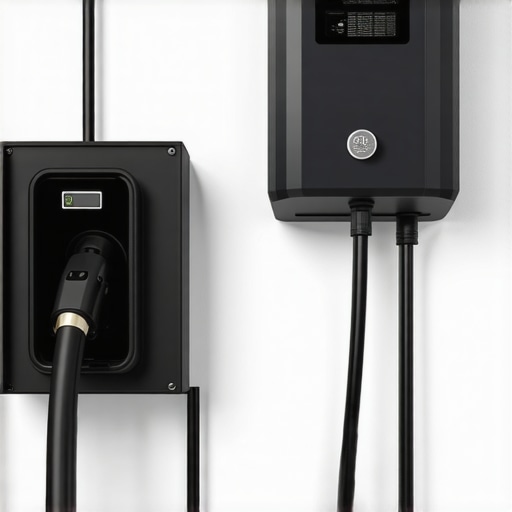
When you are presenting your plan, you have to decide between a plug-in unit and a permanent one. While many people love the idea of how we saved five hundred dollars by choosing a plug-in charger over hardwired, most property managers prefer hardwiring. Why? Because a NEMA 14-50 outlet is just another point of failure that can get hot and melt if the cheap DIY-grade outlet isn’t industrial strength. You should emphasize the benefit of a hardwired charger over a NEMA plug: it’s a more secure connection, it’s harder to steal, and it usually allows for faster charging speeds because you aren’t limited by the plug’s physical heat tolerances.
Labels and Lingo That Pass Inspection
Once you get a ‘maybe’ from the owner, you need to show you care about code compliance essentials for EV charger installations in 2025. This isn’t just about safety; it’s about liability. If a fire happens for any reason, the first thing the insurance adjuster looks at is that charger. I once saw a tenant get evicted because they didn’t have the specific circuit labels required by the electrical inspector. It sounds like a tiny detail, but to an inspector, a missing label is a sign of a hack job. You need to ensure your electrician knows the specific torque settings that prevent panel fires during high load charging. If the screws on the breaker aren’t tightened to the exact inch-pound spec, the vibrations from the 50-amp flow can loosen the wire over time, leading to an arc flash.
Fix Your Panel Before the Electrician Arrives
If your apartment was built before the 90s, your electrical panel is probably already full. You need to look for the specific panel space requirements for a level 2 install. You need two adjacent slots for a 240V breaker. If you don’t have them, you aren’t necessarily dead in the water, but you might need to discuss panel upgrades for EV chargers with your landlord. This is often where the ‘Right to Charge’ laws help—you can often pay for a sub-panel or a slim-line breaker if the local code allows it. If you’re feeling overwhelmed by the technical jargon, you can reach out for a professional consultation to get a clear list of what your specific panel needs. Remember, the goal is to present a ‘turn-key’ solution where the landlord just has to sign a piece of paper while you handle the heavy lifting and the costs.
Most homeowners look at their breaker box and think if they see two empty slots, they are ready for a Level 2 charger. This is a dangerous oversimplification that leads to more failed inspections than almost any other mistake. Physical space in a panel is just a plastic housing; what actually matters is the existing demand on your transformer and the thermal capacity of your busbars. I have seen panels with plenty of ‘room’ that were technically over-leveraged because the homeowner had already added a hot tub and an electric dryer without updating the original load calculation. Before you buy any hardware, you need to understand the specific panel space requirements for a level 2 install and realize that those slots are only half the story.
Why physical space in your panel is a total lie
Everyone says you need a 200-amp service upgrade the moment you buy an EV, but in my experience, that is often an expensive knee-jerk reaction. Many older homes can actually handle a charger if you utilize ‘smart’ load management. Instead of spending five thousand dollars on a utility upgrade, you can look into how to load balance your home electrical system without a full panel swap. This technology pauses your car’s charging if the oven and AC kick on at the same time, keeping you within the safe limits of a 100-amp or 125-amp service. It is a more elegant, data-driven solution than just throwing more raw power at the problem.
The hidden danger of the ‘budget’ NEMA outlet
Here is the ‘oops’ factor that almost cost me a garage: using a residential-grade 14-50 outlet instead of an industrial-grade one. Most people buy the $15 outlet from a big-box store, not realizing that an EV pulls a continuous load for hours. According to the National Electrical Code (NEC) Article 625, EV charging is considered a continuous load, meaning it draws 100% of its rated current for three hours or more. A cheap outlet isn’t designed for that kind of thermal stress and will eventually warp, leading to high resistance and fire. This is exactly why I advocate for the benefit of a hardwired charger over a NEMA plug. If you must use a plug, you need a Hubbell or Bryant industrial-grade outlet that can actually handle the heat.
Even the best equipment fails if the installation is sloppy. I cannot stress enough that the specific torque settings that prevent panel fires during high load charging are not optional. Most DIYers (and even some pros) just ‘hand-tighten’ breakers. But under the constant heat-cycling of an EV charge, those connections expand and contract. If they aren’t torqued to the exact manufacturer specifications, they will loosen, arc, and melt your expensive new breaker. It’s also worth a quick look to see why you should check your panel for double-tapped breakers, as these are common code violations that will get your installation flagged immediately.
Can you really run two chargers on one 100-amp service?
This is the question I get from families who just added a second Tesla to the fleet. The answer is yes, but only through power sharing (also called ‘grouping’). You don’t need a second 50-amp circuit that would definitely blow your main breaker. Instead, you install two chargers that communicate with each other to split a single 50-amp feed. If you are struggling with this, ev charger troubleshooting expert tips for common issues often point back to improper communication wiring between these ‘master’ and ‘slave’ units. You should also check how to troubleshoot a communication error between your car and charger if the handshake fails during this process. Staying ahead of code compliance essentials for EV charger installations in 2025 means embracing these smart tech solutions over old-school heavy metal upgrades. Have you ever fallen into the ’empty slot’ trap or had a landlord tell you your panel was ‘full’ when it actually wasn’t? Let me know in the comments below!
Once you have survived the installation and the inspector has finally signed off, you might think the journey is over. But honestly, the ‘set it and forget it’ mentality is how people end up with melted ports and dead units three years down the road. I treat my charger like a high-performance appliance. Every few months, I do a quick walkthrough to check for signs of wear that most people ignore. For instance, I’ve seen handles get dropped so many times the internal latch deforms. You really need to know how to stop your charger handle from sticking in the port before you find yourself yanking on a $500 piece of plastic at 6 AM. It is also vital to understand how to clean the pins on your charging handle safely using specialized contact cleaner; a little bit of oxidation can lead to massive heat buildup.
Stop Your Outdoor Unit From Giving Up
If your charger is outside, the elements are your biggest enemy. I live in a place where the humidity can feel like a sauna, and I’ve learned the hard way that ‘waterproof’ is a relative term. According to the technical white paper from the National Electrical Manufacturers Association (NEMA) regarding enclosure integrity, even NEMA 3R outdoor-rated housings can suffer from internal condensation if not vented correctly. This is why I religiously follow 3 maintenance tasks that keep your outdoor charger running through winter, including checking the seals and ensuring the cable isn’t cracking under UV exposure. If you see your charging speed dropping or if why your cars charging port is flashing yellow starts becoming a frequent mystery, it is usually a sign that moisture or dirt has compromised the connection.
How do I keep my setup running like new?
Maintenance isn’t just about the outside; it’s about what is happening inside that breaker box. I keep a non-contact infrared thermometer in my garage. Once a month, while the car is pulling its full 48 amps, I take a quick temperature reading of the breaker. If you notice a specific breaker is running significantly hotter than its neighbors, you might be looking at how to spot a dying breaker before it shuts down your charging session. This is often caused by those same torque issues we discussed earlier. If you’re comfortable, checking the specific torque settings that prevent panel fires during high load charging once a year can save your entire house. Don’t forget that software matters too—knowing how to update your charger software without calling a technician ensures you have the latest thermal management protocols from the manufacturer.
The Future is Bi-Directional
Looking ahead, we are moving away from simple one-way power. The next big trend is Vehicle-to-Home (V2H) technology, where your car becomes a backup battery for your house during a blackout. This shift means panel upgrade strategies to meet ev charging code requirements in 2025 are already evolving to include ‘smart’ transfer switches. We are going to see a lot more focus on ev charger troubleshooting expert tips for common issues related to home-grid synchronization. If you want to be ahead of the curve, I highly recommend performing the simple test to see if your garage outlet is truly grounded tonight. A solid ground is the absolute foundation for any smart-charging tech. If your ground is weak, no amount of software updates will fix your connectivity issues.
The Expensive Lessons My First Charger Taught Me
Reflecting on my early days as an EV owner, I realized that the hardest part isn’t the electricity—it is the peace of mind. First, never ignore a humming sound from your breaker box. I learned that spotting a dying breaker before it shuts down your charging session is a skill every owner needs. Second, the technical ‘handshake’ between your car and the unit is delicate; troubleshooting ev charger connectivity problems often reveals that a simple Wi-Fi signal boost or a firmware update solves everything. Finally, remember that your landlord is likely as nervous as you are. Approaching them with a plan for managed charging over individual meters often turns a ‘no’ into an enthusiastic ‘yes.’
My Trusted Checklist for a Flawless Power-Up
You do not need a degree in electrical engineering to maintain a safe setup, but you do need the right resources. I personally recommend keeping a digital copy of the latest NEC guidelines to help verify code compliance for your ev charger installation. Don’t forget to check your local city’s website for utility rebates that pay for your charger installation costs, as these can save you hundreds. For the hands-on owner, a torque screwdriver set and an infrared thermometer are your best friends for ensuring the specific torque settings that prevent panel fires remain within spec over time. These tools take the guesswork out of maintenance and upgrading your panel for better ev charging performance.
Take the Leap Toward a Fully Charged Future
Moving from the frustration of public charging to the freedom of a home unit is one of the best upgrades you can give yourself. While the initial talk about a panel upgrade or code compliance might seem daunting, the long-term savings and convenience are undeniable. Don’t let the technical hurdles of your first EV charger installation hold you back from a more sustainable lifestyle. If you ever feel like the technical jargon is getting too thick, you can always reach out for a professional consultation to clear the air. Have you ever faced a landlord who was completely against an EV install, and how did you convince them? Let me know in the comments below!